Batman: Year One and the Origin of Gotham’s Greatest Partnership
The Great DC Sightsee

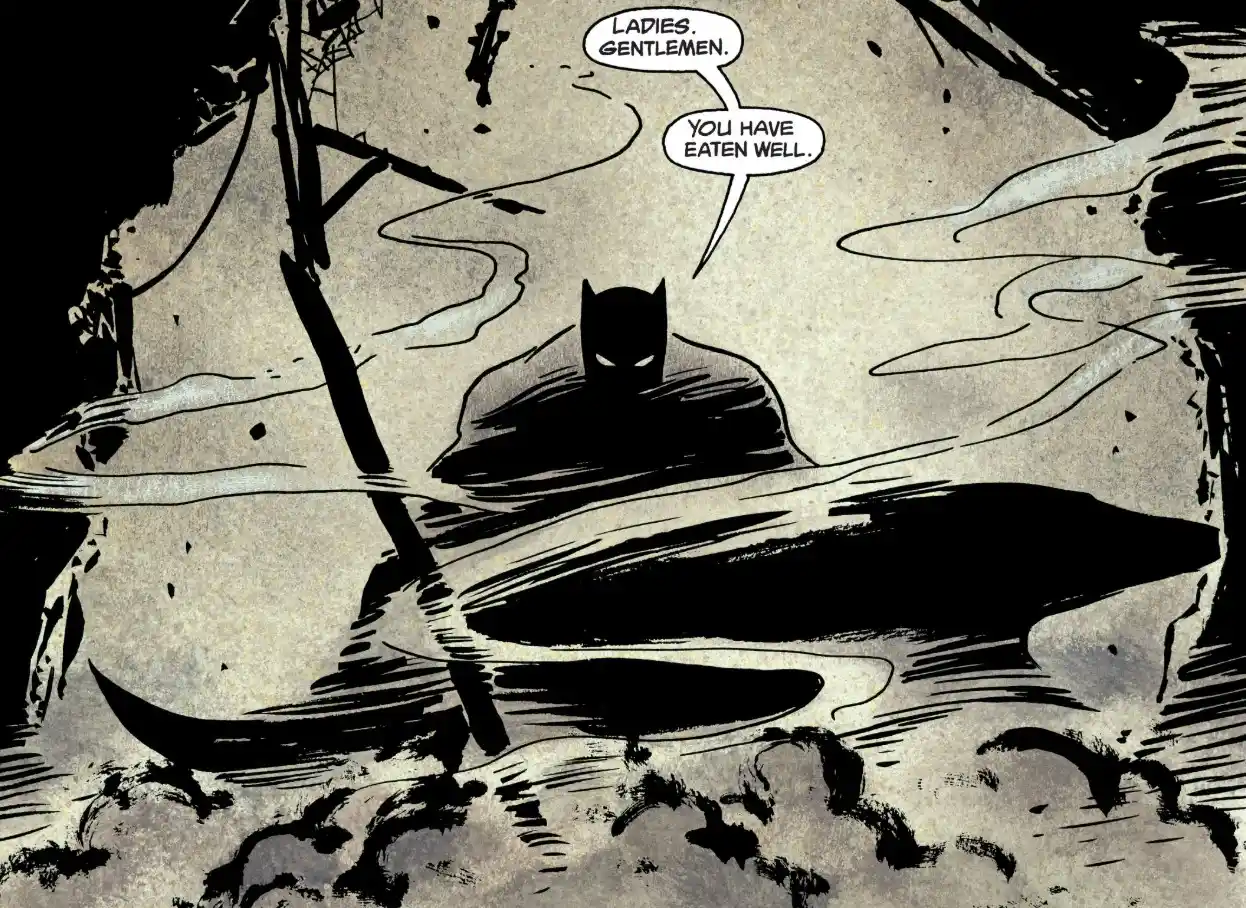
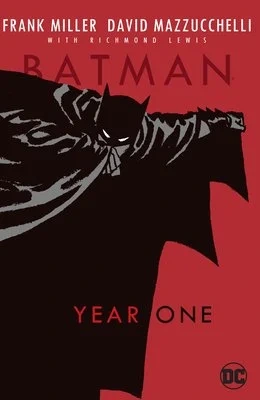
Batman is one of those characters in pop culture that has become larger than any single piece of media to which they are tied. While Bruce Wayne and his alter ego are quintessential comic book superheroes, the hero and his Gotham City setting are perhaps more well known through television shows and movies. The result of such ubiquity is an endless stream of new fans, who were introduced to Batman in one way or another, and are interested in learning about the books where it all started. These curious cats are destined to be killed by the car of continuity, with the Caped Crusaders’ adventures stretching all the way back to the early 1940s, and the lines between what actually happened to any given iteration of Batman and what is an alternate universe adventure are blurry for the casual reader, to say the least. However, ask any comic book fan for either the best place to start or the most lauded stories from the World’s Greatest Detective, and one reliable response is given time and again, artist David Mazzucchelli and writer Frank Miller’s Batman: Year One.
Coming out in 1987, Year One was a project designed to detail Batman’s early days as a vigilante. Published in the aftermath of the universe-resetting crossover, Crises on Infinite Earths, Year One established a new foundation for Batman in the revamped DC comics landscape. The book delves into the hero’s origin and examines the roots of some of his most integral relationships, including those with Jim Gordon, Selina Kyle, and the city of Gotham itself. Described as a groundlevel story, the narrative focuses on the crime and corruption that draws Batman into the world of masked crime fighting, and the limitations of his chosen framework.
Parallel to Batman’s narrative, the story introduces Lieutenant James “Jim” Gordon as a secondary protagonist. The longstanding police commissioner from the Batman mythos is still getting started and just arriving in Gotham during the first issue of the arc. While Gordon is a beloved character and can stand on his own right, as seen in these pages, he is most crucial in his role as almost a foil for the strategy that Batman takes at the outset of his campaign against crime. The reader is introduced to the depravity and hopelessness of Gotham’s broken systems, legal, political, you name it, through Gordon. Batman is a few steps ahead, imagine that, and readers see the hero acting in response to the failure of societal structures. The general dichotomy of Year One is that Gordon attempts to make a change from inside the system, while Batman works from the outside.
Lieutenant Gordon’s arc is a necessity both for the character of Batman in general, but also for the reader’s ability to suspend disbelief and buy into the type of superhero universe presented by Year One. A rich man who dons a mask and delivers extrajudicial punishment is not a setup with inherent heroism. In fact, it takes a lot of context and specific circumstances to make the whole ordeal not come across as an absurd power fantasy, which, of course, superhero comics often are. As the broken systems of Gotham and intentions of Batman are revealed to Gordon, the concept of a Caped Crusader becomes less of a far-fetched fantasy and more of a realistic, last-ditch effort to save a city. It takes a good comic to make a convincing case for the stereotypical superhero framework, but what makes Year One great is that it refuses to leave things simple.
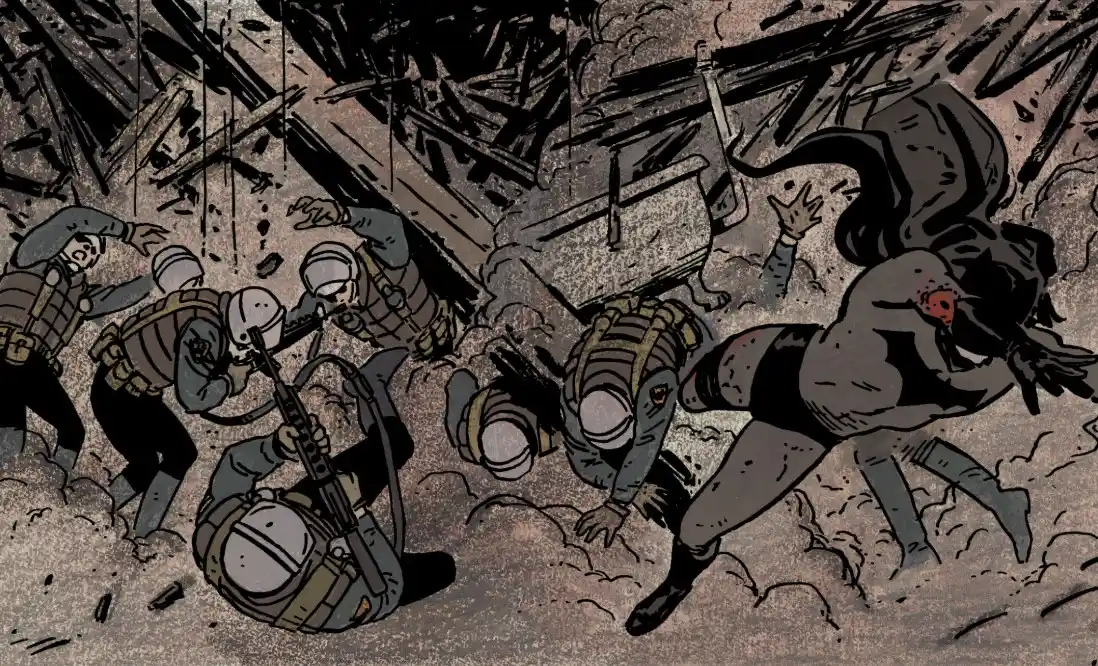
From two independent angles, Lieutenant Gordon and Batman attempt to address the city’s ailments. Gordon plays the game in the police department, he follows the rules and gets results, at least in the eyes of the public. His rise in rank is fast, but the streets don’t seem actually to get much cleaner from his elevated view. Bruce Wayne operates outside of the typical legal structures, but still within the system of brute force that Gotham understands. Batman becomes a renowned myth and strikes fear into the hearts of common criminals, but still, there are criminals all the same. Both men are forced to reckon with the reality that they cannot punch or shoot their vision of the city into being. For each of them, this comes at times when they are already questioning the value of their continued pursuit of justice in such a broken society. Their personal relationships, in the forms of Catwoman, Gordon’s family, and other loved ones, are showing them happiness, and the men are unsure if they can hold all the responsibilities they have shouldered. Batman and Gordon’s reevaluation of their overarching strategies sets the stage for their partnership, but also allows them to retain some of their delusion.
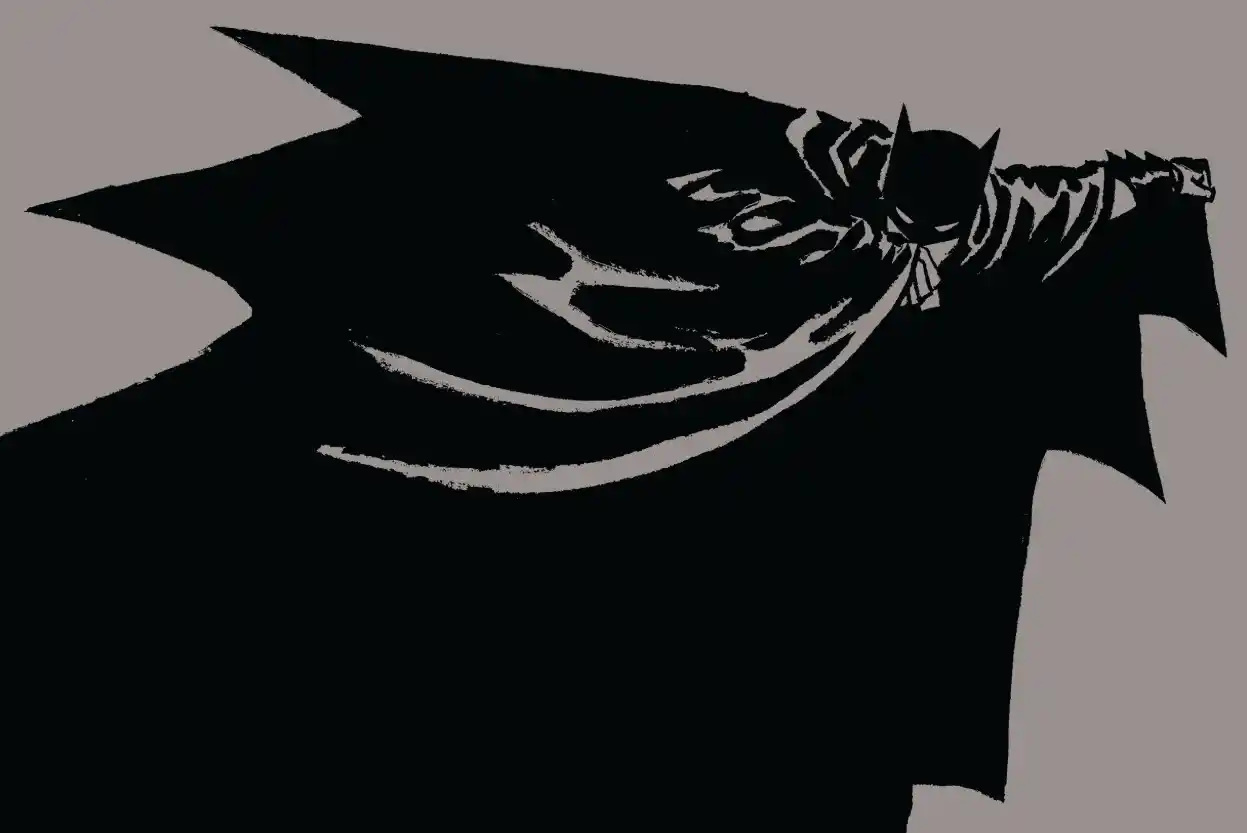
Miller writes his signature over-the-top take on crime, where events are as gritty and dark as they are wacky and far-fetched, and Mazzucchelli’s art strikes the exact right tone to highlight the unique contrast. Stylistically, the comic does not deviate too far from typical superhero standards, but there is a darkness brought on by the coloring and the soft, sketchy lines. Panel to panel, the art is fluid and supports the well-paced nature of the comic, with almost every page sporting a complete, substantive story scene. Interconnected, wobbly lines, where even the straightest edges of architecture have a slight bend or curve to them, keep the scenes kinetic and cohesive. The art and writing work in lockstep to support the story’s atmosphere of irony and defiant hope.
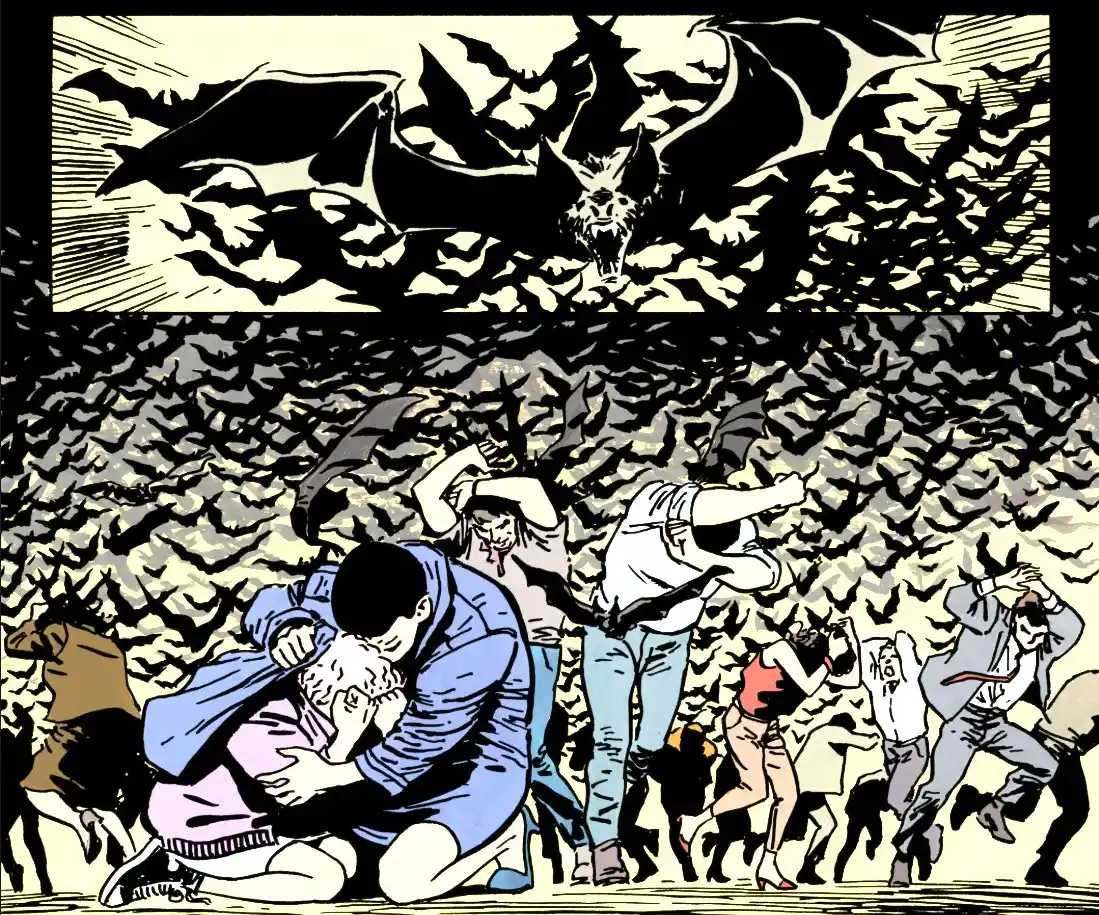
Painting Batman as Robin Hood is a hook that latches onto the reader, perhaps more effectively than many would expect. The book omits a traditional supervillain and instead grounds Batman’s crusade in more realistic crime and corruption, in the forms of drug trafficking and conspiring elites. There’s an undeniable catharsis in seeing Gordon punch the bad cop on the street and Batman take down the suit in the suite, but the melancholy and hopelessness that underscores their fleeting victories invokes a more real and interesting angle on the idea of fighting crime. Year One is determined to be a launching point for Batman comics, and it works well in that regard, and as a by-product, it is a clear example of the endless cycles of struggles that will come to define the hero.
Charming and bleak, Year One works as an introduction to the setting of Gotham City and its cast of characters as much as anything. A story of flawed, but exceptional, individuals in pursuit of a better tomorrow, either for themselves or others, comes together with evocative art to create a deep, compelling package. Some readers may see no reason to sum up the first year of Batman’s crime-fighting or retread his overall mission, especially without a single supervillain, and while that is fair enough, there is enough in this individual story to warrant a read outside of its prominent place in continuity. An origin story done right, Year One sets out to give context and encourage readers to invest in the continuing Batman stories. In this regard, the book is an entertaining success. At the same time, the comic is a dual exploration into the motivations and ambitions of two broken men fighting to be fixed. Towards this goal, the book may be more melodramatic than hard-hitting at times, but it remains a gripping read.
Citation Station
Batman: Year One. 1987. Frank Miller (writer), David Mazzucchelli (artist), Todd Klein (letterer), Richmond Lewis (colorist).