You Lose, America in Ultimates Volume 2: Power to the People
Marvel’s Ultimate Universe

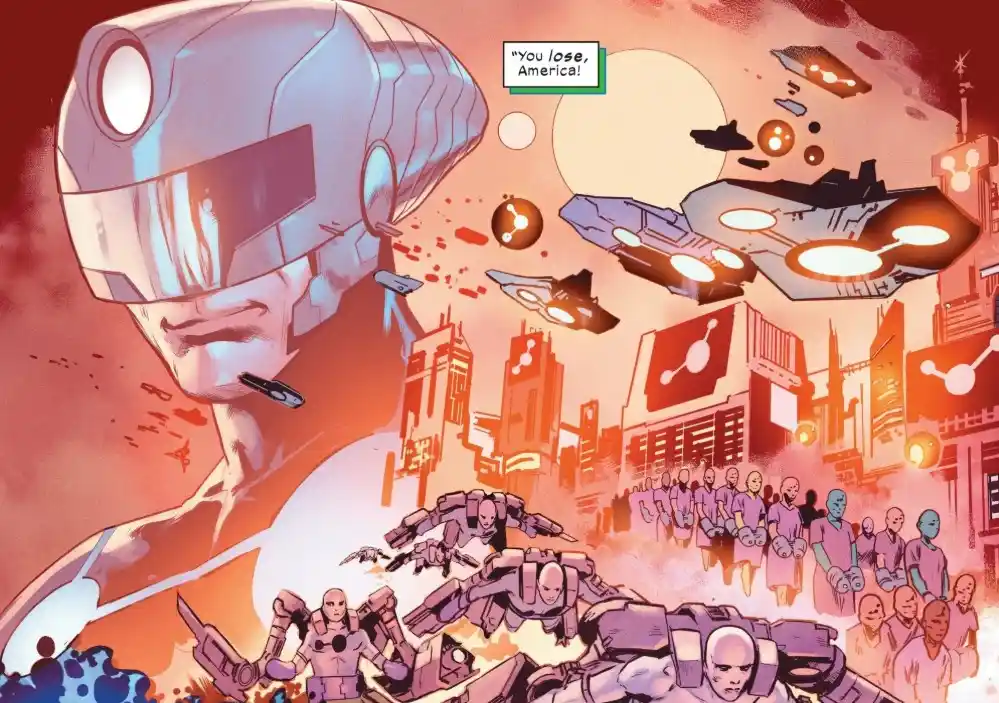
Deniz Camp was far from subtle in the comparisons he was drawing between the struggles of the Ultimate Universe’s premier superhero team and real-world forces of oppression and resistance within the initial half-dozen issues of Ultimates. In the subsequent six issues, there is no change in the confidence behind the series, but its focus becomes a lot tighter and more transparent. Power to the People is a book about building mass movements, the most effective tactics of change, and the practical limitations of small groups of good-hearted individuals, despite their capabilities. In a world full of super prisons and American nazis, the Ultimates fight a war more familiar than readers may expect.
The structure of Ultimate Volume 2 is loose, with each issue being quite insular and the connective tissue being minimal between them. This framework is a continuation of that which is established in the first volume, though the sequel brings down the walls between chapters a bit in comparison. Each issue is very much its own story, with its own main character and focus, but the book never loses its place within the wider universe. While it is the ostensible central series to the Ultimate line, the movement of the main plot is glacial and tangential in these pages. Instead, the story is more concerned with exploring the alternate world and fleshing out to the reader what exactly will be waiting for outside The City, as the reader ponders the inside at the same time. Multiple perspectives, populations, and adventures are offered, with the thread of revolution running between them all.
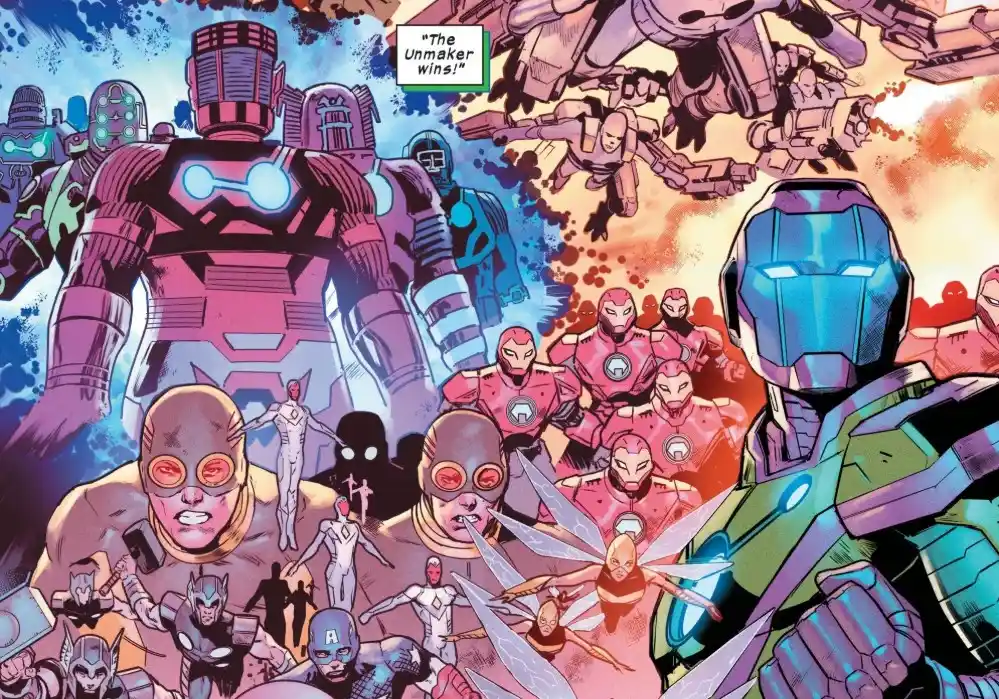
One of the more interesting concepts is the Guardians of the Galaxy. The team shows the reader what the Ultimates could be fighting for by showcasing a utopian timeline, and offers a refreshing perspective on the universe. Of course, there is more than Earth in an alternate timeline, and it is compelling to see other time travelers and alien visitors interact with Earth as it is explicitly being ravaged in battle over time. The sequences with the Guardians also play well into the message being pushed by Captain America, in that time travel is not the solution to creating change. There is a theme building in the series over the importance of working with the present, and an emphasis on the hubris of hoping for a miracle.
The elephant in the room is the dynamics presented by the Guardians, which are glaring in their reminiscence of Hickman’s House of X/Powers of X comics. By mirroring the X-Men series so directly, such as a character seeing all the future possibilities and being explicit that the heroes lose in every single one, the series starts to pull back the curtain on various shared elements. There is a clear comparison between the direction Hickman was taking Marvel’s mutants and the overall heading of the Ultimate line. A time travel setup that establishes a losing position and limited time frame, worldwide political shakeups with leadership vacuums opening and being filled, and a big metal device within which time moves faster and an inevitable doom will emerge. These similarities are not bad in their existence, but readers may start to get the feeling that they have been here and done this all before.
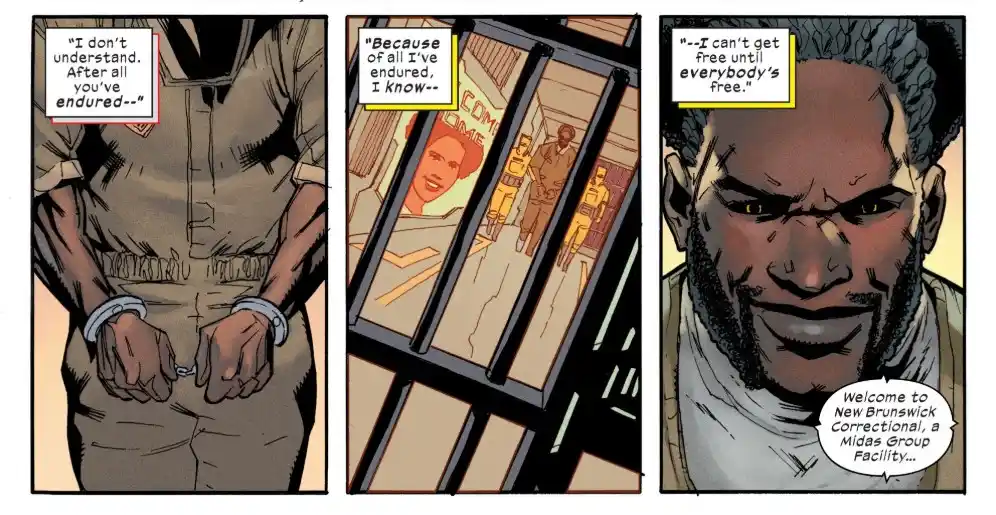
Outside of the time travel shenanigans, Ultimates spends time showing what has become of America, and explores ways to fix the crumbling, nazi-plagued country. Through the perspectives of Luke Cage, Captain America, and the Human Torch, the series makes its social commentary inescapable. From top to bottom, the infestation of fascism, nazism, and mass incarceration is examined and challenged in a blunt, up-front manner. “All Power to the People” becomes a rallying cry from Luke Cage, who explains to the reader that they are all engaged in one fight from different fronts. The red skulls being punched by Captain America, the human captors keeping humans imprisoned alongside Luke Cage, and the everyday struggles of regular people are all results of the same broken system. Parallels between the real-world moment and in-fiction situation are so direct that there are key moments where readers will find themselves wishing the superheroes would come out of the pages and address the problems surrounding them. It’s a hard balance to strike, given the reality of most comic books, but being able to invoke that emotion of inspiration and admiration is rare and exciting to read.
Thor gets his own issue in the book, and it is very much in line with the rest of the themes of revolution. Readers see the thunder god go to any extent to return familiarity to Asgard, with art that is arguably a step above the rest of the series just in terms of being interesting. The final issue of volume 2 is more introspective and deals with the overarching plot and interpersonal relationships of the Ultimates. If the message of collective action did not somehow come through at this point, the characters all but spell out the lessons they learned over the past issues, and how they plan to apply them.
At the end of the second volume, readers may not be sold on the Ultimates as a team. While there are some good character moments, the series does not seem to have the time or intention of diving too deep into the personalities and histories of the group. Instead, Ultimates is more concerned with delving into the world around the heroes and building up the reasons for which they fight. It’s for that reason that although the titular superteam’s connection with the reader may still be weak, Ultimates as a book is strong and well worth the read.
Citation Station
Ultimates Volume 2: Power to the People, 2025, Deniz Camp (Author), Christopher Condon (Author), Juan Frigeri (Illustrator), Chris Allen (Illustrator), Alessandro Cappuccio (Illustrator), Dike Ruan (Cover Art).